Tuesday, July 11, 2017

Of locks and low bridges

I thought I would entertain you with some workings of locks on the river and how the ship copes with very low bridges.

We are now on the Rhine - Main - Danube canal, joining the two major rivers of Europe and allowing shipping traffic to travel from the Black Sea in the east to the North Sea. It is three times shorter than the same trip via the Mediterranean and the ocean. However, because of geography and changing levels along the river, locks are needed to raise and lower the shipping.

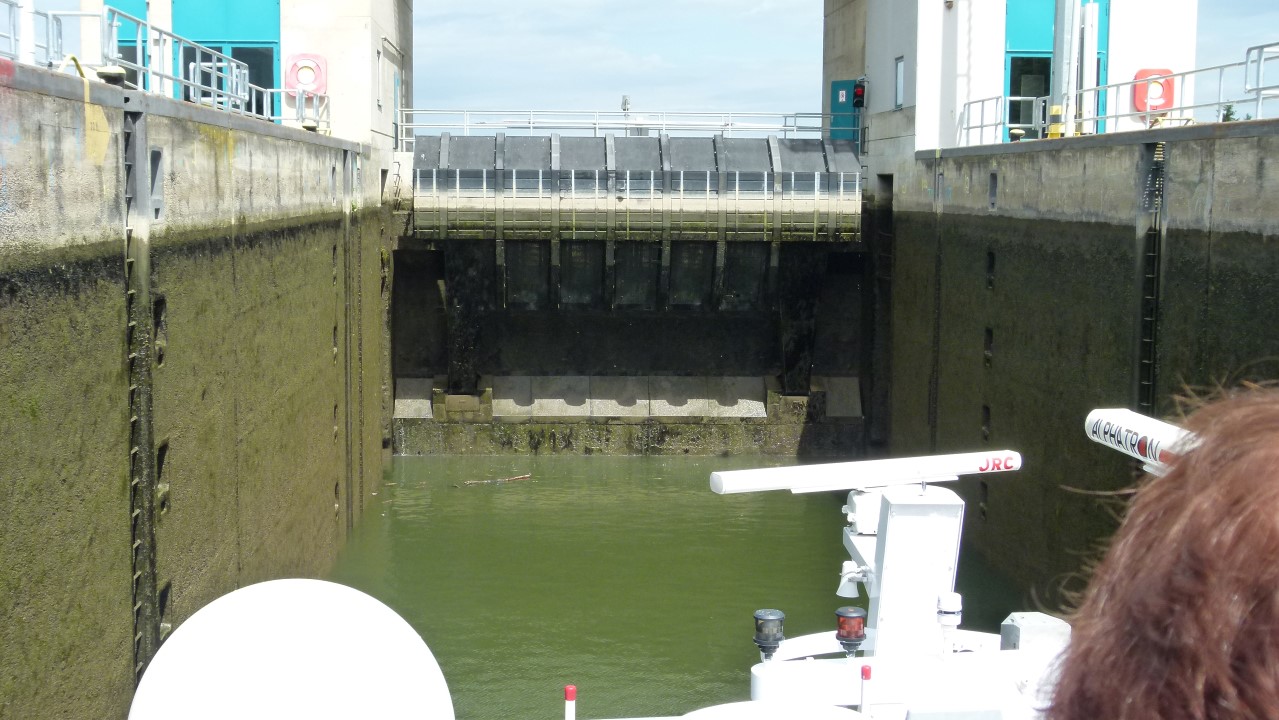
Leerstetten lock
Here is one of the deepest locks at Leerstetten, 24.6 meters or 90 feet. It is one of three locks that are 90 feet in displacement.


Waiting to enter lock
Here is our ship is parked at the side waiting to enter the lock. Another ship at the bottom of the lock is currently coming up.


Ship in lock
Here's the other ship just coming into view as it rises from the bottom of the lock. Notice the gate in front of it.


Lock gate descending
Here you can see the upstream gate descending to allow the other ship to leave the lock. It cannot descend until the water levels on both sides of the gate are equal.
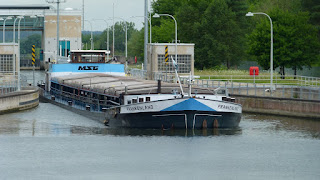


Ship leaving lock
Now the gate is fully down, the ship can leave the lock and we can now enter it.


Entering the lock
Here we are slowly entering the lock. The lock is 12 meters wide, our ship is 11.4 meters wide, leaving just 30 cm clearance on either side. So skilled is the pilot that he guides the ship in, all 135 meters of it, without touching the sides.


In the lock

Here we are, fully in the lock and tethered to the side. Behind us the upstream gate is raising into position in preparation for draining the lock to descend us to the lower level.


Going down

The water is being released from the lock and we have begun descending. Note the water line to see how far we have actually gone at this point.


Still going down

Bottom gate emerging

Finally the downstream gate emerges from the water, 20 meters down.


Downstream gate raising
Now the water level is equal with the water on the other side, the downstream gate begins to open.


Holding pens for water

Now, you're probably wondering where all that water goes when the lock empties - well wonder no more. Behold, the holding pens for the water next to the lock. About 80% of the water is recycled, some escapes downstream but the locks are kept topped up by an artificial lake constructed next to the canal.
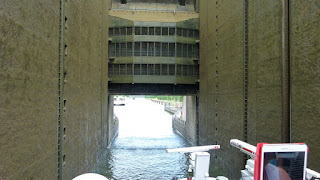


Downstream gate fully open
Note the entire wall does not open, it's just too big. The downstream gate is large enough to let the ships go through and no larger!
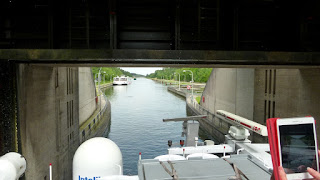


Exiting the lock

25 meters (90 feet down) we slowly glide out of the lock.


Not much head room

As you can see, there isn't much clearance at the bottom!


Aqueduct

This canal also has a unique feature in that it has an aqueduct that crosses a road below it. The canal is 171 km long and was first conceived in 793 A.D. by Charlemagne the Great. Unfortunately, the technology of the time was not up to the challenge so the project was shelved. It wasn't till 1834 that Ludwig I of Bavaria passed a law for the construction of the canal. It was called, strangely enough, the Ludwig canal and was completed in 1844 after 8 years of construction.


Aerial view of aqueduct

As soon as it was built it was too narrow for shipping so it had limited use until 1962 when the current canal's construction was commenced, completing in 1992. The canal cost 2.3 billion euros to build, and has 16 locks ranging from 6 meters high to 24.6 meters.


Very low bridge
Something else the canal has plenty of and that is very low bridges. We're not allowed on top of the ship when these come near so this is the closest I could come to this bridge.


Wheelhouse

This is the wheelhouse. It has a unique feature.


The bridges are so low, the clearance is insufficient for the wheelhouse to go under it so...the wheelhouse goes down - it sits on hydraulic rams that can lower it.


So here it is going down lower...


And finally it is so low, the pilot has to open a hatch in the roof and poke his head through to see where he's going. What happens when he reaches the bridge? He ducks!

BTW, you can click on the pictures to see them larger.

Sunday, July 9, 2017

Salzburg - 8th July

Mondsee
Today we arrived in Brandstatt and after an early breakfast we caught the bus for a two hour drive to Salzburg, home of Mozart and the Sound of Music. On the way we stopped at Mondsee, a comfort stop, if you get my drift, but this is so different to our roadside stops in Australia. It's a full on food court with main meals, delicious looking cakes and strudels and a view to die for. Those are the Austrian Alps you are looking at, they stretch all the way from Slovenia to France.

Salzburg Gardens & Fortress
Our guide entertained us during the trip with many facts about Austria, the Alps, the immigration crisis of 2015 and many other interesting stories.
On arrival in Salzburg he took us on a walking tour, first to these gardens at the right with an amazing view of the fortress on the hill above the city. This fortress was built in 1077 A.D. and has had a long and colourful history.


Pegasus Fountain

Next to the gardens is the Pegasus Fountain. Now why do I bring this fountain up? Apart from the cute duck at the base of it, almost hidden by the vegetation it was eating, this was where the scene in The Sound of Music was filmed where Maria teaches the Von Trapp children how to sing with the Do-Re-Me song.


Padlock bridge
We then crossed a pedestrian bridge to the old city of Salzburg and this bridge has thousands of padlocks attached to by lovers professing their undying love to each other. Our guide says many of them break up, and the locks have to be periodically removed because they cause too much pollution when they rust.


Birth place of Mozart
Then it was into the centre of the old city and to the house where Mozart was born. The yellow building with the window open on the first floor is where he was born. Mozart left Salzburg at a young age and went to Vienna. He never returned to his birth place.


Levitation
In the main cathedral square was a Mozart impersonator with an unusual act. It appears he is levitating above the square with only his hand resting on a piano tilted at a crazy angle and balanced on  a pile of books.
The trick to this is the large iron plate under the red rug on the ground, from that a hidden frame comes up through the books and piano and goes up the sleeve on the piano to a harness hidden under his silver costume which holds him in the air, seemingly "levitating". Very clever illusion.
Sound of Music

After some free time in the centre of Salzburg, we were whisked up to a mountain top 1001 metres above the city for a meal and entertainment from the Sound of Music. Food was OK, but the entertainment was spectacular, with songs from the movie such as The Hills are Alive with The Sound of Music, The Lonely Goatherd (complete with yodelling and seven children emulating the Von Trapp Children, Do-Re-Me (also with the children) and finally Eidelweiss. "Maria" was our lovely hostess, she sang the opening song and introduced all the rest of the acts. Very enjoyable.

After that it was another two hour drive in the bus back to Passau in Germany to rejoin our ship.

Hey guys, where are the comments? Is anyone following this blog? To top it off, the "g" key on my brand new laptop has come loose and is becoming decidedly temperamental. Hopefully it will hang on till I get back to Australia.

Saturday, July 8, 2017

Durstein and Melk - 7th July

Kuenringer Castle
Today we docked in the picturesque town of Durstein (dry stone), a quaint medieval village on the banks of the Danube in the beautiful Wachau Valley. It's main claim to fame is the ruins of Castle Kuenringer that sits on a hill above the town. King Richard I (the Lionhearted) was imprisoned here by Duke Leopold V of Austria from 1192 to 1193 on his return from the 3rd Crusade. Legend has it that Blondel, a favourite court minstrel of King Richard's, searched through Europe for months for the king, and was singing a song that they had both written together, when he heard it being repeated from the Kuenringer Castle and had him rescued from his imprisonment.

Durstein main street
Durstein Abbey
The town itself is picture postcard perfect with narrow cobblestone streets and many gorgeous buildings, such as the blue Durstein Abbey.

Ros and I spent two hours walking around this quaint town before returning to our ship.


There are many, many cruise ships on the Danube, we pass them and they pass us all the time. In fact, there are so many that the ships have to double and sometime triple dock and we have to walk through the other ships to get to shore, as displayed below. Our Cruise Director, Patrick, says "We built many, many boats but we did not build enough rivers".

Triple docked


After that we sailed for the town of Melk, famous for it beautiful and imposing abbey set upon a rock promenade above the town. We toured it for over an hour but unfortunately we were not allowed to take photos inside, so I only have this view of the main courtyard to show you.

Melk Abbey

It has been a Benedictine monastery since the 11th century and has a colourful and varied history, including a fire in the 13th century that destroyed most of the building, including the library with its priceless books and scrolls. The current library is full from the floor to the ceiling of books dating back 7 centuries, all bound in leather and written in Hebrew, Greek and Latin. The church is just incredible to behold and I don't have words or pictures to describe it, but it takes your breath away. Gold inlay, soaring roofs and columns, frescoes on ceiling and everything just incredibly ornate.

Sundowner
Whilst cruising the river, just about every bend reveals another castle, either in ruins or still actively being used. I'll not bore you with pictures of all of them because after seeing one castle, you've just about seen them all. After finishing at Melk Abbey, we were bussed to the ruins of another castle, Burgruine Aggstein Castle, for a sundowner. I bravely climbed up to the parapets to record the incredible view displayed below. After that, both very tired by a full day touring, we returned to the ship for tea and early to bed as tomorrow we have to be up early for our day trip to Salzburg.

View from Burgruine Aggstein castle

Friday, July 7, 2017

Vienna - 6th July

Last night we docked in Vienna, had an early tea then we were bussed into Central Vienna to the Palais Lichtenstein for a concert by the Vienna Hofburg Orchestra.

Palais Lichtenstein
We had to get dressed up in our finest for this event so that meant digging out my dinner jacket and Ros getting into one of her dresses.

As you can see from the picture, Vienna doesn't do things by halves. The Palais Lichtenstein was formerly the Garden Palace for the Royal Family of Lichtenstein. Inside there were royal carriages from the 18th century, amazing frescoes painted on the ceilings and of course, the orchestra itself.

Royal carriage
The Royal Carriage pictured is just one of 92 carriages Queen Maria Theresa brought with her when arriving for her wedding to Francis Stephen Leopold - Francis I Holy Roman Emperor. Although technically Francis was the ruler, Maria Theresa actually reigned Austria from 1740 till her death in 1780. Her titles included Holy Roman Empress, German Queen, Archduchess of Austria, Queen of Hungary and Croatia, Queen of Bohemia plus two more pages of titles!

Vienna Hofburg Orchestra
Schonbrunn Palace
We were treated with delightful music from Johan Strauss I & II, Mozart, Beethoven and others. We also had some arias performed by the lovely lady pictured here, who had an incredible voice and was backed by that superb orchestra. They played many of my favourites including Mozart's Eine Kleine Nachtmusik (A Little Night Music), Strauss Junior's On Der Schonen Blauen Danube (On the Beautiful Blue Danube) and Strauss Senior's boisterous Radetzky March which had the audience clapping along enthusiastically.

Today we were taken to Schonbrunn Palace, as our guide described it, the weekend residence for the Austrian Royal Family as it only had 1441 rooms. The Habsburg Palace in Central Vienna was the main residence and had over 2000 rooms. The name Schonbrunn translates to beautiful springs, referring to the artesian spring that originally was on the site of the palace.

Great Hall - Schonbrunn Palace
Our very knowledgeable guide took us on a tour of just a few of the rooms in the palace and the opulence and decorations of the rooms just has to be seen to be believed. Cameras were not allowed inside the palace, but I managed to find a picture of the Great Hall for you to see. Incredible ceiling frescos and gold inlays galore feature in all the rooms, this room alone used 2 kg of gold for the gold leaf decorations. The chandeliers originally held candles and legend has it you could tell if Maria Theresa was going to hold a long or short party by the length of the candles installed in the chandeliers. When the candles burnt out, the guests were unceremoniously "booted out".

Gardens, Neptune's Fountain & Gloriet
Parliament House
Out the back of the palace are the gardens, highlighted by Neptune's Fountain and the Gloriet up on the hill which commemorated all of Maria Theresa's achievements during her reign. As it so happens this year is the 300th anniversary of her birth so celebrations are large and long. We stopped to have coffee and Vienna's most famous Apple Strudel, which we had to admit was the best we had ever tasted. We had intended to catch the train which takes you around the whole complex, but alas it filled up just as we arrived so we missed out. We instead walked down to Neptune's Fountain but decided not to venture up the hill to the Gloriet because of Ros's knee causing her grief.
Afterwards we toured the city seeing many of the sights but alas to capture them successfully from the bus window proved difficult. I did manage to get this picture of the marvelous Parliament House as we drove by it.

Tonight we depart for Durnstein.

Wednesday, July 5, 2017

Slovakia - 5th July

Yesterday afternoon at 4.15pm we departed Budapest on our way to our next stop, Vienna in Austria. We sat in the lounge watching the scenery go by, as you do. It was interesting to see out in the countryside, how many houses were dotted amongst the trees lining the Danube. Occasionally you see a small town, always with the obligatory church spire poking above the trees. Last night we had a formal sit down dinner after the Captain’s toast and meeting all the staff. It was just divine to watch the scenery go past while eating your meal. It stayed light enough till 9pm to see all the sights going past.

At 9pm we were entertained by a traditional Hungarian music ensemble together with two male and two female dancers in traditional Hungarian costumes. Their dancing is very energetic, with lots of twirling, foot stomping and knee slapping. By 10 pm, still jet-lagged, we were falling asleep in the chairs so we retired for a very good night’s sleep.

Today we woke up, opened the curtains to reveal…a concrete wall! We were in the first of 64 locks between Budapest and Amsterdam. We watched as they flooded the lock and the ship slowly rose up 50 feet to the top of the lock, then slowly sailed out. The lock is long enough for our ship, plus two others. 
Leaving lock

Right now I am on the sun deck on top of the ship typing this and the capital of Slovakia, Bratislava is just hoving into  view. We have each been issued with a TailorMade device, a combination GPS, electronic guide and radio receiver with earpiece. With it we can set it on River Guide and it automatically starts talking to you when passing a site of interest and explains everything about it. When we are on guided tours, our tour guide can talk to us via the radio connection so we don’t have to be right next to them to hear the commentary. Ingenious devices indeed.
Ros on Sun Deck with TailorMade around her neck

Bratislava is a beautiful city, spanning the banks of the Danube. It has five bridges across it, the most beautiful being the Apollo Bridge, a uniquely designed and built bridge, constructed in one span on the shore then rotated in one piece into position. It is a blue and white and has no right angles at all in its construction.


UFO Bridge of Bratislava
The most unusual bridge (Bridge of Slovak National Uprising, but colloquially is known as the UFO Bridge of Bratislava) has a single suspension pole at one end with what looks like a flying saucer on top of it, which contains a restaurant and viewing platform. 
Apollo Bridge


Bratislava Castle
Most prominent on a hilltop overlooking the city is Bratislava Castle, an elegant four spired structure with solid walls surrounding it. It was built in the 9th century but now holds the centre of government of Slovakia.


We did not stop in Bratislava, just passed on through to Vienna which we will reach tonight. After an early tea, we will be bussed into the Palais Lichstenstein to hear a concert, featuring Strauss, Brahms, Beethoven and others. Vienna is of course, considered the centre of music in Europe and we are eagerly looking forward to this

Tuesday, July 4, 2017

Budapest - 4th July

We arrived in Budapest yesterday (3rd July) after a gruelling 34 hour journey with little to no sleep. Eight hours from Perth to Hong Kong that was delayed an hour, then another 30 minutes circling Hong Kong when we got there, a 7 hour layover at Hong Kong airport, a 12 hour flight to Munich followed by a 1 hour flight to Budapest. Needless to say, we were very tired by the time our pickup at Budapest airport delivered us to our cruise ship. We arrived at 8.30 am but our room was not ready so we fell asleep in the lounge. Boarding time was supposed to be 3 pm, but fortunately the crew took pity on us and had our room ready by 10.30 so we fell into bed. I was asleep almost as soon as my head hit the pillow.

Now refreshed after a good night's sleep, I can finally get this blog going. Hong Kong airport is enormous, it has over 500 gates! We had booked a lounge there to rest in during our 7 hour layover, so we asked directions and was told it was next to Gate 1, so down to Gate 1 we toddled only to be told that online bookings had to go to the other lounge, down at Gate 40! Poor Ros was footsore by then, but fortunately there were travellators most of the way to help us finally get there. When we left to catch our onward flight, there was a sign for our gate pointing downwards, so we caught the lift down and there's a freaking train there to take us to our gate! We were certainly glad we didn't have to walk to that one!

Airbus A340-600
Scenic Jewel
The plane we took from Hong Kong to Munich was an Airbus A340-600, one of only three long haul planes with four engines, the other two being the 747 and the A380. It has a basement, all five economy toilets were down there under the main cabin - the only plane I have seen with this feature.

I was leaning on a wall in the middle of the night waiting for a vacant toilet, when the "wall" opened and I almost fell onto a flight attendant emerging from the crew sleeping quarters. I don't know who was more surprised, her or me!

Our ship is the Scenic Jewel, a 135m floating hotel and we have a balcony suite so we can watch the scenery glide by whilst in our cabin. It has a large electrically operated window stretching the entire length of the balcony, which can be lowered to expose the balcony to the open air. We have been advised to keep it closed at night as the summer insects are attracted to the light.

Parliament House
The staff are wonderful and oh so helpful and the food is to die for! The captain informed us there are 64 locks between Budapest and Amsterdam that the ship must negotiate, fortunately most of them at night time while we sleep. Last night after dinner, the ship cruised up the river through the central district of Budapest so we could see some of the main attractions lit up, the best being the Parliament House, but the bridges are also spectacular, seven of them spanning the Danube in the city environs.

Matthias Cathedral
Today we toured Budapest by bus, but we did make two stops, one on the Buda side (Budapest is actually two cities divided by the Danube, Buda is on the western side and has large hills, whereas Pest on the eastern side is dead flat), the Matthias Cathedral, a beautiful Roman Catholic church with picturesque colourful roof tiles and a towering Gothic style, complete with gargoyles. It and most of Buda was destroyed twice, once during the Turkish invasion in the 16th century and again by the Soviets during World War II. It has been rebuilt in its original style and is simply gorgeous, both inside and out.

Liberty Bridge
The other stop was at the Hungarian Music Academy to listen to a  piano recital by Csaba Kiraly, a world-renowned pianist/organist who has won the Franz List award twice in his 46 years of experience. Man, could he tickle those ivories, managing not one or two separate melodies but up to five at once! Then he hopped on the giant pipe organ and blasted out a number on that as well. Certainly very enjoyable.

This afternoon we set sail on the first stage of our trip, leaving Hungary behind and passing through Slovakia on our way to our next stop, Vienna in Austria.

Some notable people have been born in Budapest, Franz Listz - famous composer, Zsa Zsa Gabor - actress and one Eric Weisz, whom you probably better know as Harry Houdini, the famous escapologist and magician.


Sunday, June 25, 2017

European River Cruise

Our luxury liner

Hi all

Off on a trip of a lifetime, cruising from Budapest, Hungary to Amsterdam, Netherlands.

Our itinerary is listed below, more detail when actually there.

July 2nd - depart Perth 7am - Hong Kong (8 hour layover) - Munich - Budapest (arriving 3rd July around 8 am)

3rd July - board our Scenic cruiser, the Scenic Jewel
4th July - tour of Budapest
6th July - Vienna
7th July - Melk
8th July - Salzburg
9th July - Regensburg
10th July - Nuremberg
11th July - Bamberg
12th July - Wurzburg
13th July - Freudenberg
14th July - Rhine Gorge - Rudesheim & Marksburg
15th July - Cologne
16th July - Amsterdam tour
17th July - end of cruise, fly to Boston via Zurich
17th-19th July - stay with Averil & Neil in Boston
19th July - drive to Fairfield, Connecticut to visit Josh's in-laws, Rick & Nancy
23rd July - fly to L.A. stay with Luke, Michelle and Joshua at various times
10th August - depart L.A. via Auckland
12th August - arrive home